
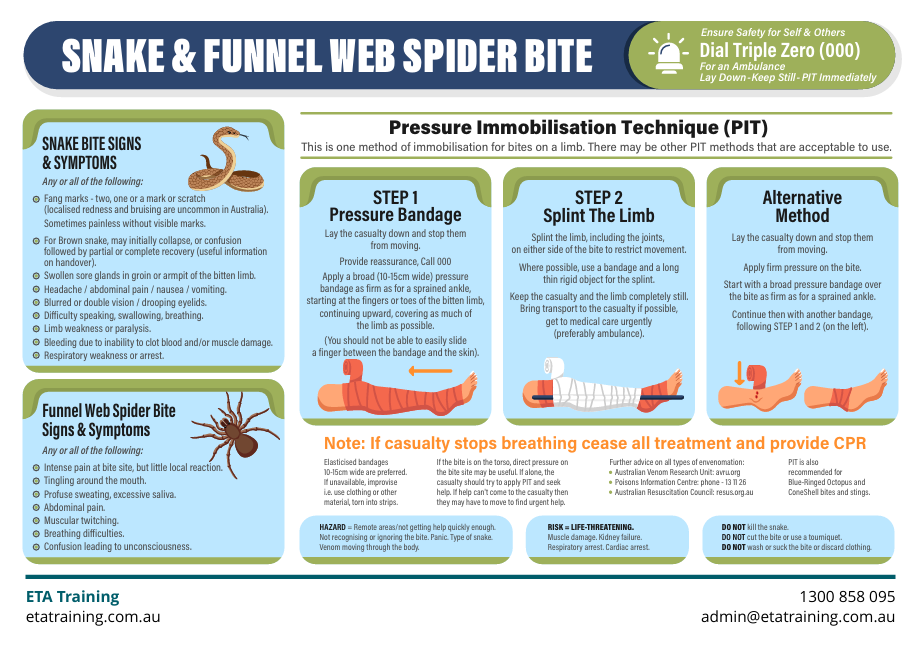
Australian snake bite first aid is built on two things: a pressure immobilisation bandage applied to the bitten limb, and keeping the patient completely still until an ambulance arrives. This article sets out what the current Australian guidance says and why.
What Does Australian Snake Bite First Aid Involve?
Australian resuscitation guidance for snake bite, published by the Australian and New Zealand Committee on Resuscitation, consists of three parts:
1. An ambulance is called for any suspected bite.
2. A pressure immobilisation bandage is applied to the bitten limb.
3. The patient is kept still, kept calm and kept under constant observation until help arrives.
The technique is called the pressure immobilisation technique (PIT), and the guidance is specific about the bandage, how firmly it is applied, how much of the limb it covers, and how the limb is then splinted so it cannot move. Bandages and splints are not removed until the patient has been assessed in hospital.
Should a Snake Bite Be Elevated or Kept Below Heart Level?
Neither. This is one of the most common questions about snake bite, and the framing of the question is itself the problem.
Australian guidance does not ask you to raise the bitten limb or to lower it. It asks you to keep the patient and the limb completely at rest. Repositioning a limb, in either direction, means moving it, and movement is the thing the entire technique exists to prevent.
Advice about keeping a bite below heart level circulates widely online. It comes largely from overseas guidance written for snakes whose venom causes severe local tissue damage, which is a different clinical problem to the one Australian snakes present. It should not be applied here.
Snake Bite First Aid Myths That Still Cause Harm
Do not apply an arterial tourniquet. Cutting off blood supply to a limb causes its own serious injuries and is not part of Australian guidance.
Do not cut or incise the bite. It does not remove venom, and it creates a wound.
Do not try to suck out the venom. It does not work, and it delays the treatment that does.
Do not apply ice. It offers no benefit and risks further tissue damage.
Do not rely on a snake bite kit or suction device. Commercial venom extractors do not remove a meaningful amount of venom and can waste critical minutes.
Do not try to catch or kill the snake. It puts you at risk of a second bite, and many Australian snakes are protected species. If it is safe to do so, a photograph taken from a distance may help with identification.
Do not remove clothing to get to the bite. Undressing a patient means moving the limb. The bandage is applied over clothing if that is what is in the way.
Why the Bite Should Not Be Washed
The bite should not be washed because venom left on the skin and on clothing is used by hospitals to help identify which snake was responsible, which in turn guides treatment. Washing it away removes that information, and Australian guidance is explicit that the bite is neither washed nor sucked.
Washing is one of the most understandable instincts after a bite, and one of the least helpful actions.
Many snake bites also leave no obvious mark. The absence of clear puncture wounds does not mean no venom was injected, and a suspected bite is treated as a bite.
Every Suspected Snake Bite is an Emergency
All snake bites are treated as potentially life threatening. Call triple zero (000) and ask for an ambulance.
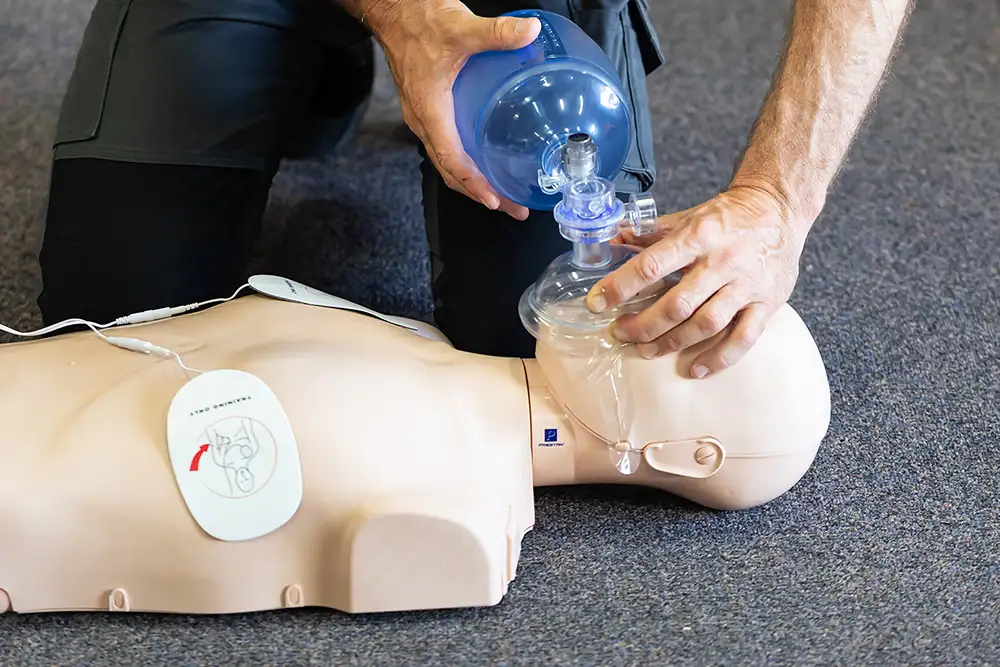
The most common cause of death following a snake bite is collapse with cardiac arrest, and it typically occurs between ten and sixty minutes after the bite, most often before the patient reaches hospital. That is why the response to a snake bite is not only about the bandage. If the patient becomes unresponsive and is not breathing normally, CPR is started immediately. There is no risk of venom being transmitted to a rescuer providing CPR.
The wider sequence for an unresponsive patient is the DRSABCD action plan, which every nationally recognised first aid course in Australia teaches.
Snake Bite Risk in Western Australia
Snakes are most active in Western Australia from early spring through to early autumn, roughly October to April, as temperatures rise and breeding season begins. They are far less active through the cooler months.
The dugite and the tiger snake are the two dangerously venomous species most commonly encountered in the Perth metropolitan area. The gwardar, also called the western brown, the mulga snake and the southern death adder are also present in the metropolitan area and more widely across the state. All are best left alone. If a snake needs to be removed from a property, the Parks and Wildlife Service Wildcare Helpline on (08) 9474 9055 can provide advice and put you in touch with a licensed reptile remover.
Most bites happen when someone tries to handle, move or kill a snake. Leaving the area, keeping children and pets indoors, wearing enclosed footwear in long grass, and using a torch after dark remove most of the risk.
Where Snake Bite First Aid is Taught
The pressure immobilisation technique (PIT) is covered in the nationally recognised first aid course delivered by ETA Training. Participants apply the technique themselves under a qualified trainer and are assessed on it, which is the part that cannot be replicated by reading about it.
Courses run across three Perth locations, and booking is completed online in four steps:
- Book using the online course calendar. Choose the course, choose the day, and pay online via the secure booking portal at any time.
- Complete online learning units in your own time. The link to complete online theory is emailed once the face-to-face session is booked. Online units must be completed before the date of the course.
- Complete practical units at the training centres. Attend the classroom face-to-face session on the day and time of booking. Venues: Wangara, Welshpool, Treeby.
- Receive your training certification. Once both pre-course theory and face-to-face practical components are completed, the certificate is issued.
Your Statement of Attainment is typically issued on the same day of successful course completion.
Visit the first aid course page to check session availability and book online.
First published 18 September 2023. Reviewed and updated 11 August 2026 against ANZCOR Guideline 9.4.8, Envenomation: Australian Snake Bite.


