
.jpg)
AS/NZS 3760:2022 is the Australian and New Zealand standard for the in-service safety inspection and testing of electrical equipment and residual current devices. It sets out how equipment that is already in use is inspected, tested and tagged, and it covers single phase and three phase equipment connected to a low voltage supply by a flexible lead. This article explains what the standard covers, which equipment falls inside and outside its scope, the five tests it requires, the limits that apply, and who is permitted to carry the work out.
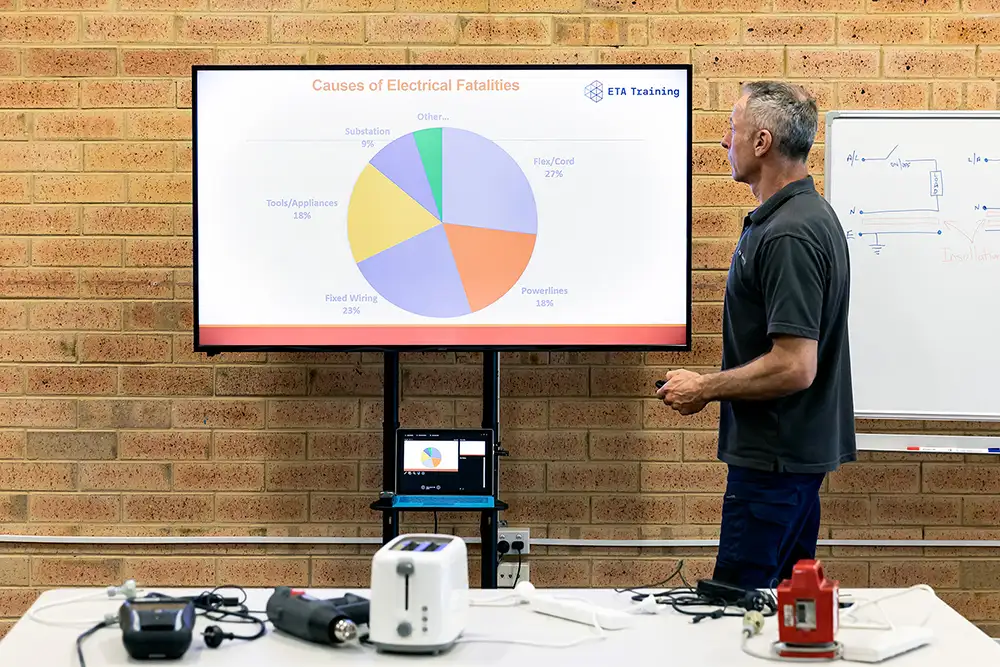
Are Australian Standards Mandatory?
Australian Standards are not law in themselves, but they become mandatory wherever legislation requires compliance with them. Standards are published documents that provide guidance on safety, performance and reliability. They carry legal force only when a regulation points to them.
Western Australia provides a clear example. The Electricity (Licensing) Regulations 1991 state that an electrician shall carry out electrical work in accordance with the standards specified in schedule 2 of those regulations. The word "shall" is what makes the listed standards mandatory rather than advisory.
Standards Australia publishes the standards and operates as a non-governmental, not-for-profit organisation.
What Equipment Needs to Be Tested?
Equipment that should be inspected and tested under AS/NZS 3760:2022 includes:
- New equipment
- Equipment already in use
- Equipment that has been serviced or repaired
- Equipment purchased second hand
- Equipment that is available for hire
The standard also sets out the procedure for testing residual current devices installed in electrical installations, and portable residual current devices.
What Equipment Is Outside the Scope of AS/NZS 3760:2022?
The standard does not apply to equipment that cannot be safely or practically tested in service, or that is covered by another standard. The following items sit outside its scope:
- Electrical equipment installed at a height of 2.5 metres or greater
- Equipment that must be dismantled to perform the inspection and tests, where any dismantling is work for a competent person
- Residual current devices used to supply medical equipment
- Fixed or stationary equipment that is not exposed to a hostile environment
- Medical electrical equipment
- Portable generators within the scope of AS/NZS 3010:2017
- Demonstration stock in retail or wholesale outlets
Who Is a Competent Person Under AS/NZS 3760?
A competent person is someone with the practical and theoretical skills to correctly carry out inspection and testing, acquired through training, qualification, experience, or a combination of those. The standard does not require an electrical licence for in-service testing of the equipment it covers, which is why non-electrical staff can be trained to do the work.
The guidance on the electrical knowledge a competent person needs covers:
- Basic electrical principles, including alternating and direct current and the units of amps, ohms and volts
- Circuit protection, including fuses, circuit breakers and residual current devices
- Electrical safety, including the effects of electrical current and safe work practices around electricity
- Inspection and testing to AS/NZS 3760:2022, including classes of equipment, types of insulation, insulation resistance, leakage current, and the correct and safe use of test equipment
On a recognised test and tag course that knowledge is assessed rather than assumed, which gives an employer something to point to if it ever has to show the person doing the testing was competent.
What Tests Does AS/NZS 3760:2022 Require?
AS/NZS 3760:2022 requires a visual inspection followed by a set of electrical tests, with the tests applied depending on the class and type of equipment. The visual inspection is the most important of them, because in general around 90 per cent of faults are identified visually.
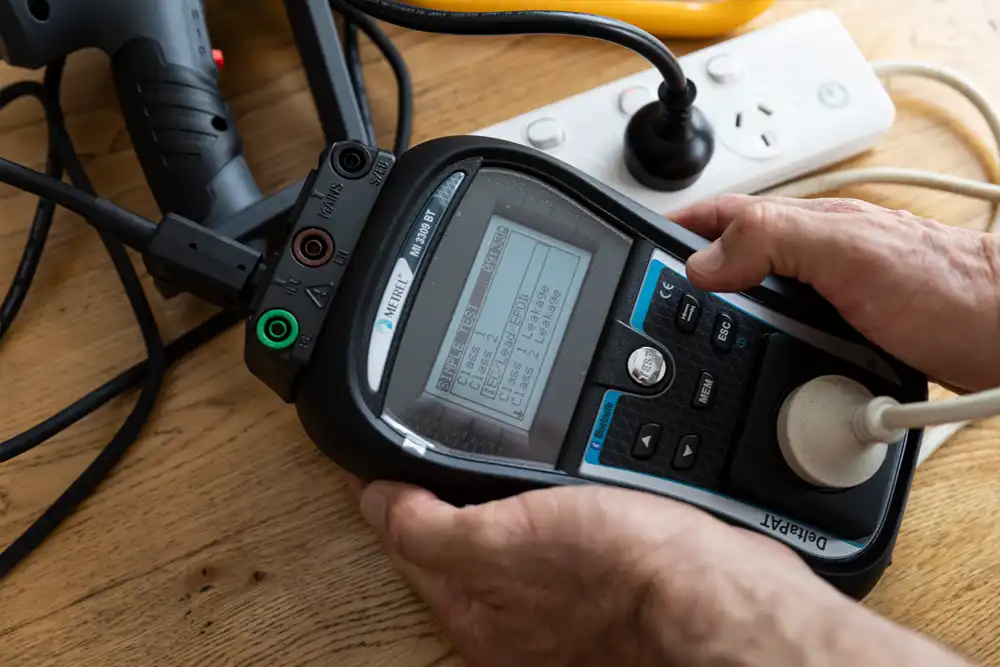
Visual Inspection
The visual inspection checks the condition of the cord, plug, appliance body, guards and socket for damage, wear or misuse. All equipment should be visually inspected, and equipment that fails the visual inspection is removed from service without proceeding to the electrical tests.
Polarity Test
The polarity test confirms that the active, neutral and earth conductors are connected to the correct terminals. Cord sets and cord extension sets with rewirable plugs must be checked for correct polarity, because a rewired plug is the point at which conductors are most often crossed.
The conductor colours for flexible cords in Australia are:
- Active: brown
- Neutral: blue
- Earth: green and yellow
Earth Continuity Test
The earth continuity test confirms that the protective earth path has a low enough resistance to operate the circuit protection if a fault occurs. The measurement is taken between accessible metal parts and the earth pin of the plug. For extension leads, power boards and portable residual current devices, the measurement is taken between the earth connection at the plug and the earth connection at the socket.
The measured resistance must not exceed 1 ohm.
Insulation Resistance Test
The insulation resistance test measures the integrity of the insulation separating the live parts from the accessible parts, using a nominal test voltage of 500 volts DC. A minimum insulation resistance of 1 megohm applies.
Where equipment contains surge protection devices such as metal oxide varistors, the 500 volt test can damage those components or produce a false failure. A nominal test voltage of 250 volts DC may be used instead in that situation.
Leakage Current Test
The leakage current test measures the current escaping from the equipment while it operates at its rated voltage, and it is an alternative to the insulation resistance test rather than an addition to it. Because the equipment is energised during the test, a shock hazard may be present.
For a full explanation of what the test measures on each class of equipment and the limits that apply, see what is a leakage test. For guidance on which of the two tests to use in a given situation, see insulation test versus leakage current test.
What Are the Classes of Electrical Equipment?
Equipment is classified by the way it protects users from accessible metal parts becoming live if insulation fails during normal use. The class determines which tests apply.
Class I equipment relies on basic insulation between the live parts and the accessible metal parts, combined with earthing of those metal parts. Equipment where some accessible metal parts require protective earthing is Class I.
Class II equipment relies on double insulation or reinforced insulation between the live parts and the accessible metal parts, with no protective earth. Class II equipment is generally manufactured with a non-conductive enclosure and is marked either DOUBLE INSULATED or with the square within a square symbol.
How Should Residual Current Devices Be Tested?
Residual current devices require both a push button test and a trip time test at different intervals. The push button test confirms the mechanism releases. The trip time test measures how quickly the device actually disconnects the supply, which the push button test does not reveal.
The push button test applies every six months for fixed residual current devices and every three months for portable ones. It is highly recommended that a push button test is conducted every time a portable device is used. The trip time test applies every twelve months for both fixed and portable devices.
Maximum tripping times are:
- Type I, rated at 10 milliamps, with a maximum tripping time of 40 milliseconds
- Type II, rated at 30 milliamps, with a maximum tripping time of 300 milliseconds
How Often Should Equipment Be Tested and Tagged?
The retest interval depends on the type of equipment and the environment it works in, and the standard sets those intervals out in Table 2.4. Intervals range from as often as daily through to five yearly. A tolerance of around two weeks either side of the ‘Next Test Due’ date is generally accepted, and an interval can be varied on the basis of a documented risk assessment.
How often an appliance or piece of equipment needs to be tested and tagged will generally depend on the environment in which it is used. An appliance used on a construction site requires more frequent testing than equipment used in a lower risk environment, such as an office.
What Records Must Be Kept?
Records of inspection and testing should be kept for all equipment that is inspected or tested. The records that apply are:
- A record of all equipment
- A record of formal inspections and tests
- A repair register
- A record of all faulty equipment showing details of the service or corrective action taken
Records should be retained for seven years, or for the period the relevant regulator requires. Electronic records are acceptable for the purposes of the standard.
Where to Learn Test and Tag to AS/NZS 3760:2022
ETA Training runs test and tag courses in Perth covering the requirements of AS/NZS 3760:2022 and how they apply in practice, including the use of test instruments under supervision. For those testing three phase equipment, the three phase test and tag course extends the same competency. Nationally recognised certification is also available Australia-wide through the online test and tag course.
Booking runs in four steps. Choose the course and the day and pay through the secure online calendar. Complete the online learning units in your own time before the face-to-face date, using the link emailed after booking. Attend the practical session at Wangara, Welshpool or Treeby. Receive certification once both the theory and the practical components are complete.
Useful Links
- Test and Tag Course, Perth
- Online Test and Tag Course, Australia-wide
- What is a Leakage Test?
- AS/NZS 3760:2022, available from Standards Australia
- Safe Work Australia, guide to testing and tagging portable electrical equipment and residual current devices at workplaces
First published 2 May 2024. Reviewed and updated 26 August 2026 against AS/NZS 3760:2022.
Heading 1
Heading 2
Heading 3
Heading 4
Heading 5
Heading 6
Lorem ipsum dolor sit amet, consectetur adipiscing elit, sed do eiusmod tempor incididunt ut labore et dolore magna aliqua. Ut enim ad minim veniam, quis nostrud exercitation ullamco laboris nisi ut aliquip ex ea commodo consequat. Duis aute irure dolor in reprehenderit in voluptate velit esse cillum dolore eu fugiat nulla pariatur.
Block quote
Ordered list
- Item 1
- Item 2
- Item 3
Unordered list
- Item A
- Item B
- Item C
Bold text
Emphasis
Superscript
Subscript


